The Sisi Museum and the Imperial Silver Collection are open again. The redesigned route through Vienna’s Hofburg opened on 19 November 2026, Empress Elisabeth’s name day. Sisi Museum admission is included with Vienna E-pass. If you already have a pass, use the Hofburg and Sisi Museum entry instructions to arrange your visit.
Two details make the reopening especially interesting for returning visitors. You can now enter the White-and-Gold Rooms, which were once used as government offices and had never been part of the public route. And the Silberkammer, the Imperial Silver Collection, has moved from the beginning of the visit to the end. That second change matters if you’re booking a late ticket: the nearly 30-metre Milanese centrepiece will be one of the last things you reach.
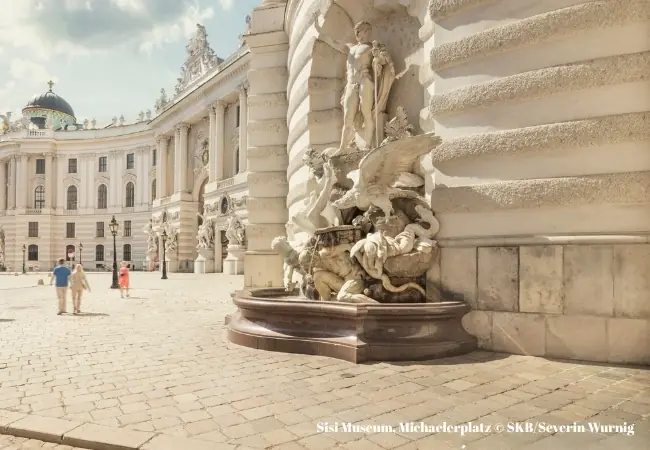 The Hofburg seen from Michaelerplatz. If you already have a valid timed ticket, head for the passage beneath the copper dome.
Planning a visit? The museum opens daily from 09:00 to 17:30, including public holidays. Last admission is 16:30. The museum recommends starting by 16:00 to enjoy the Sisi exhibition, Imperial Apartments and Silver Collection.
Why was the Sisi Museum closed?
The Hofburg was built as an imperial residence. By 2025, around 927,000 people a year were visiting the Sisi Museum. Moving visitors between the historic rooms upstairs and the exhibition spaces downstairs had become a challenge. Schönbrunn Group redesigned the route, added a staircase and lift, and restored rooms that could bring more of Elisabeth’s personal belongings into public view.
The work happened in stages. If you’ve read that the museum closed in 2023 and also that it closed in October 2026, those notices referred to different parts of the building.
| Date |
What visitors could see |
| From 1 April 2023 |
The Imperial Silver Collection closed for redevelopment. The Sisi Museum and Imperial Apartments continued welcoming visitors during much of the project. |
| 6 October–18 November 2026 |
The exhibition devoted to Elisabeth closed for the final refurbishment phase. Visitors could still see the Imperial Apartments on a reduced route. |
| From 19 November 2026 |
The redesigned route opened with the restored White-and-Gold Rooms, expanded displays about Elisabeth and the Silver Collection as the final stop. |
If you visited in October or early November 2026, you may remember walking through imperial rooms while signs said the Sisi Museum was closed. You saw the apartments during the weeks when the exhibition about Elisabeth herself was unavailable.
Sources: Sisi Museum refurbishment notices and Schönbrunn Group’s reopening announcement of 19 November 2026.
What changed inside the Hofburg?
The White-and-Gold Rooms are open to visitors for the first time
The most significant addition is a suite of Rococo rooms along Schauflergasse. The imperial family and members of the court once used them as a retreat. Much later, the Federal Chancellery used them as offices. Even visitors who knew the old museum well had never been able to walk through these rooms on an ordinary visit.
One of the best things to see is beneath your feet. A newer floor had covered the historic walnut parquet. Restorers uncovered and repaired it, along with the tiled stoves that once heated the rooms. The white walls and gold decoration are easy to notice; the parquet is the detail that reveals how much of the old palace had been hidden in plain sight.
Elisabeth’s clothes show how she lived as well as how she appeared
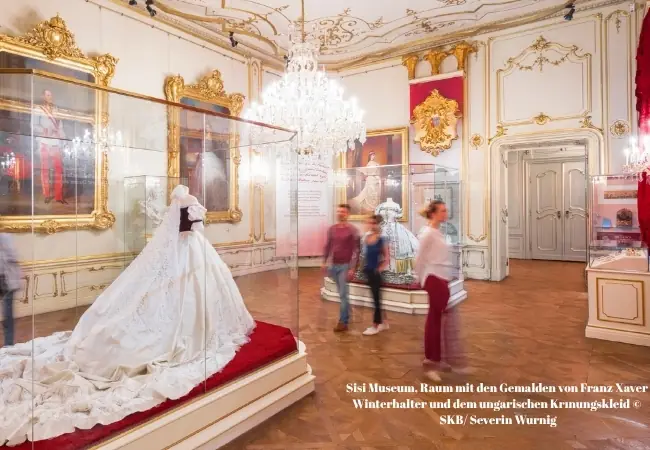 The Hungarian coronation dress display shows the public image of an empress. Elisabeth’s riding and exercise clothes offer a more personal comparison on the reopened route.
The new displays include a lime-green dress, champagne-coloured lace jacket, black lace mantilla and black satin shoes. A pair of gymnastics trousers and riding spurs tells a different part of the story. Look for both: the formal garments show how Elisabeth appeared at court, while the sports clothes show what she needed to be able to do in them.
Another highlight is the grand piano Bösendorfer made for Elisabeth, decorated with gold ornaments and small sculpted figures. Some of the most personal exhibits are much smaller. A shoe fastening belonged to her daughter Gisela. The child’s harp and school uniforms belonged to Crown Prince Rudolf, and a dress and silk ankle boots belonged to Marie Valerie. Those objects give you a sense of the children growing up in a residence that can otherwise feel very formal.
A portrait commissioned by Franz Joseph
Near the end of the suite is a portrait of Elisabeth painted by Leopold Horowitz in 1899, after her death. Franz Joseph commissioned it and had a studio set up inside the Hofburg so he could visit the artist and follow the work. Knowing that changes the picture: you’re looking at an image of Elisabeth that her husband watched take shape.
Source: Sisi Museum, reopening exhibition and collection highlights.
Is the Silberkammer open again, and what can you see?
Yes. The Imperial Silver Collection reopened with the redesigned route on 19 November 2026. A staircase and lift in the Marschallhof now connect the historic upper floor with the visitor areas below. You see Elisabeth’s story and the imperial living spaces before reaching the objects used to set the court’s tables.
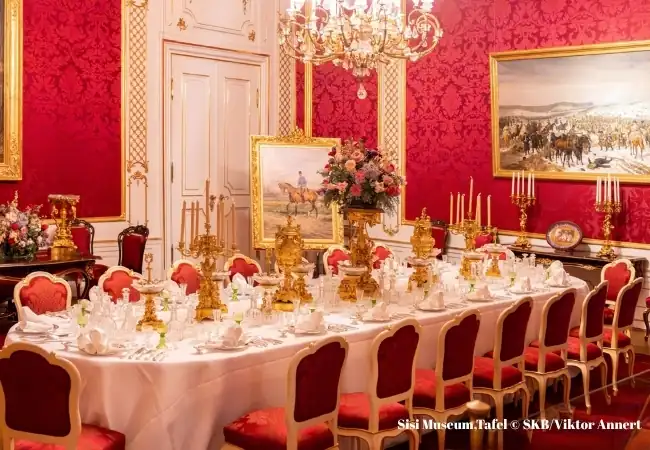 An imperial dining setting at the Hofburg. After the apartments, the Silver Collection gives you a closer look at the objects that made court dining possible.
The name “Silver Collection” only hints at what’s here. The displays cover three centuries of dining and include porcelain, glass, bronze and precious metals, alongside objects from the imperial kitchens and confectionery. Three exhibits are particularly worth finding:
- The Milanese centrepiece. Made in 1838 for Ferdinand I’s coronation as King of Lombardy-Venetia, this ensemble stretches around 30 metres. The new layout lets you get closer and walk beside it. View one section from the side, then look along its length to appreciate what a guest at that table would have seen.
- Maria Theresa’s personal silverware. After the scale of the Milanese ensemble, these pieces bring dining back to one person. For children, there’s a simple question to take to the display: which objects still look like something you used at breakfast?
- The Laxenburg porcelain centrepiece. Look for the portraits worked into the decoration. They brought the Habsburg ancestors to the table, even when the occasion was dinner.
The museum suggests about 20 minutes for this section. If you collect porcelain, enjoy design or have waited for the Silberkammer to reopen, give yourself longer. An earlier entry time buys you the freedom to stop here at the end.
Sources: Sisi Museum, Silver Collection reopening highlights and visitor timings.
Where is the Sisi photo experience, and how does it work?
If someone has told you about a “Sisi photo machine”, look for the interactive room called Dress like Sisi. It’s in the section about Elisabeth’s public image, alongside film stills, posters and star postcards. Visitors can digitally try on historical gowns. The original garments remain on display in their cases.
It’s worth seeing the clothes first. Choose something to look for, such as a sleeve, a neckline or the shape of a skirt. Then see how the silhouette changes when a gown appears on you. It gives children and adults something specific to compare when they reach the screen.
Can you take the picture home? The museum’s reopening announcement confirms the virtual fitting experience. It gives no details about printed photographs, email delivery, QR downloads or a separate fee. If you want a souvenir, ask at the installation what’s available that day. In German, „Kann ich das Bild speichern oder ausdrucken?“ means “Can I save or print the picture?”
Can you use your own camera inside?
The museum’s published house rules allow personal, non-commercial photographs and videos with restrictions, including no flash, tripods or selfie sticks. A separate heritage-conservation page gives stricter wording. Follow the signs in the room you’re visiting and ask a member of staff if you’re unsure. At the digital installation, check before photographing a screen that includes other visitors. Commercial photography requires separate permission.
Sources: Sisi Museum, Dress like Sisi reopening description, visitor house rules and heritage-conservation guidance.
Sisi Museum ticket prices, pass admission and visiting time
Buying directly from the museum? The standard day ticket has a fixed admission time. The operator names Imperial Tickets as its official online shop. Check whether the option you’re selecting is standard admission or a visit with a live guide, particularly if two prices appear for the same day.
| Standard admission |
Price listed in November 2026 |
| Adult | €27 |
|---|
| Child aged 6–18 | €16 |
|---|
| Student aged 19–25 | €25 with the required student identification |
|---|
| Visitor eligible for the disability concession | €25 with valid identification |
|---|
For an individual student concession, the museum specifies an international student identity card (ISIC). Prices can change seasonally, so check your date when booking.
Considering Vienna E-pass? Sisi Museum admission is included. If the Hofburg is one of several places you want to visit, compare pass prices, durations and included attractions against your actual itinerary. If you already hold a pass, use its attraction entry instructions before purchasing a separate €27 adult ticket.
How much time does the complete visit take? The museum suggests about one hour for the Sisi Museum and Imperial Apartments together, plus 20 minutes for the Silver Collection. That gives you a starting point of about 80 minutes inside. Allow extra time for the cloakroom, the digital gowns and the displays you want to linger over.
Is 16:30 too late? You can enter at 16:30, but closing time is 17:30. That leaves an hour for a route the museum estimates at about 80 minutes. If you want to see the Silberkammer properly, follow the museum’s recommendation to begin by 16:00 or choose an earlier slot.
Sources: Sisi Museum official day-ticket prices, ticket conditions and opening hours.
How to reach the Sisi Museum and find the correct entrance
Take the U3 to Herrengasse and walk towards Michaelerplatz. If you already have a valid timed ticket, the visitor entrance is beneath the great copper dome, known as the Michaelerkuppel. Search for Michaelerplatz in your map app. A search for “Hofburg” can direct you towards a different courtyard in the same sprawling palace complex.
If this is your first U-Bahn journey in Vienna, our guide to buying and validating Vienna public transport tickets explains how to use the station machines or the WienMobil app before you travel.
Still need an individual museum ticket? The museum places the individual ticket office in the inner palace courtyard, to the left of the Kaisertor. The group ticket office is beneath the dome. Knowing which ticket you already have can save you a wait at the wrong counter.
Step-free access, coats and bags
The refurbishment added a lift in the Marschallhof, and a ramp connects the White-and-Gold Rooms. If you need a step-free approach, ask staff beneath the dome for the lift route before joining the stairs. The museum also lists a companion concession for eligible visitors whose disability ID specifies an accompanying person.
The redesigned cloakroom can be reached from two sides. Backpacks, large bags, umbrellas and bulky items are restricted in the exhibition rooms. If you’re arriving from the station with a suitcase, confirm storage before bringing it to a timed visit.
Sources: Sisi Museum arrival instructions, accessibility information, ticket conditions and visitor rules.
Is the reopened Sisi Museum worth a second visit?
If you visited between April 2023 and autumn 2026, the clearest reason to return is the Silver Collection. You can now walk beside the Milanese centrepiece. If you came during the final October–November closure, you also missed the part of the exhibition devoted to Elisabeth herself.
If you saw the museum before 2023, come back for the White-and-Gold Rooms. Those rooms were previously off the public route. The restored walnut floor, Elisabeth’s riding spurs and the piano made for her give you three things to seek out even if you remember the old silver displays well.
If this is your first visit, remember the order: Elisabeth’s story, the imperial living spaces, then the table laid for the court. Choose a time that lets you enjoy the last part. The longest object on the route is waiting near the end.