At five minutes to twelve on Vienna’s Hoher Markt, try telling the time without looking at your phone. The great gold clock above the street has no hands to follow. Instead, a historical figure carries the hour across a row of minute marks. Once you see how it works, you can read the Ankeruhr from the pavement. Then noon arrives and the clock breaks its own routine: the whole cast comes out.
If you’re walking there now
- Where: Hoher Markt 10–11, 1010 Vienna. Look up for the clock on the bridge between two buildings.
- When: The full musical procession is scheduled daily at 12 noon, Vienna local time.
- Cost: Free to watch from the street. You can walk straight up without booking.
- How much time: Aim to arrive around 11:50 and keep your plans open until about 12:20. That gives you time to find a view and enjoy the roughly quarter-hour procession.
- Useful U-Bahn stops: Stephansplatz or Schwedenplatz.
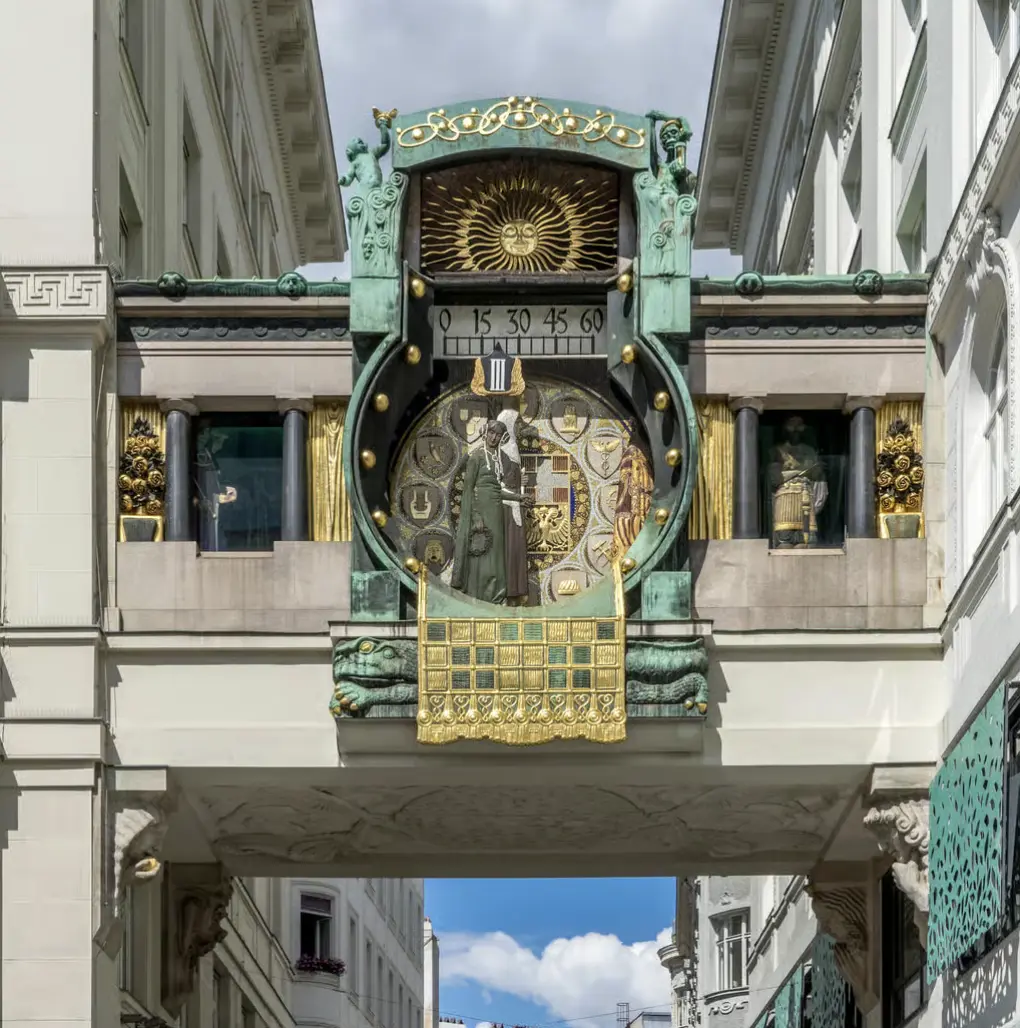 Look for the bridge above the street. For a view of the clock face, stand back far enough to see the gold sun at the top.
What happens at the Ankeruhr at noon?
On an ordinary hour, one figure or group takes an entire hour to travel across the clock. At noon, all twelve groups pass in sequence, each accompanied by music chosen for it. That difference matters if you’ve come especially for the show. Turning up at 1 pm gives you a chance to see the clock keeping time, but the full procession has already finished for the day.
The pleasure is in watching the centuries change. The sequence begins with the Roman emperor Marcus Aurelius and eventually reaches Joseph Haydn. In between, you’ll see people who ruled Vienna, defended it and helped build it. Listen as one figure gives way to the next. The change in music is a useful cue to look up again if you’ve been checking a photograph.
Where should you stand for the best view?
Start on the side facing the decorated clock face. If you can see the Roman hour numeral, the row of minute marks and the sun above them, you have the right side. It’s tempting to walk straight underneath the bridge, especially when the people in front of you stop there. For the show, take a few steps back instead. You want to see both ends of the dial without tipping your head all the way back.
For a photo, first frame the buildings on either side. That wide shot captures what makes the Ankeruhr unusual: an entire clock stretches across a street. Then zoom in for a second picture when a figure reaches the middle. If you want a short video, start before the next figure appears so you catch the change in both movement and music. Keep doorways and the walking route clear while you watch.
Is it worth visiting if you miss noon?
Yes, especially if you enjoy architecture or are already near Stephansplatz. Give yourself five or ten minutes. Find the current figure, work out the time, then walk under the bridge for a different view of its construction. If seeing all twelve figures with music is your priority, save the procession for another day at noon. Waiting for the next hour won’t bring it back.
How to tell the time on Vienna’s Anker Clock
Read the clock in two steps. First, look above the figure’s head for a winged Roman numeral. That gives you the hour. Next, look along the horizontal scale to see how far the figure has travelled. Its position gives you the minutes. The scale is divided into twelve five-minute intervals, with the quarter hours marked. A figure takes sixty minutes to cross it.
Try it: the figure carries XI and is halfway across. What time is it?
About 11:30. XI gives you eleven, and halfway across a sixty-minute journey gives you thirty minutes. If the same figure has reached the three-quarter mark, it’s about 11:45. Try this before the noon procession, while the clock is showing its ordinary hourly movement.
This makes a good game if you’re visiting with children. Give one person the numerals and another the minutes. For a younger child, skip the numbers altogether and ask them to spot the butterfly above the clock. There’s a reason the artist put it there.
Why is the clock called the Ankeruhr?
The name comes from Anker, the insurance company whose buildings the clock connects. Uhr is German for clock, which is why English maps and guidebooks may call it the Anker Clock or Anchor Clock. All three names take you to the same place. Artist Franz von Matsch designed it in the Viennese Art Nouveau style, known locally as Jugendstil. It was completed in 1914.
Knowing who commissioned it makes one detail particularly satisfying. Above the clock, a child with a butterfly represents life. On the other side, Death holds an hourglass. For an insurance company, the passage of time was a meaningful subject to place over its doorway. You can take in that idea from the square even if you don’t recognize a single emperor.
Which figures are easiest to recognize?
There’s a point to the order. Marcus Aurelius takes you back to Roman Vienna. Hans Puchsbaum, a master builder associated with St. Stephen’s Cathedral, gives you someone to look for if you’ve just come from Stephansplatz. Maria Theresa appears together with her husband, Francis Stephen of Lorraine. Two people can share one hour, which explains why counting individual heads gives a different impression from counting the twelve groups.
Finally comes Haydn. After a succession of rulers and military figures, it’s a composer who closes this little history of Vienna. If you’re standing with someone who would happily skip a clock to get to a concert, that’s the figure to point out.
↑ Back to contents
How to find Hoher Markt from central Vienna
From St. Stephen’s Cathedral: Head towards Rotenturmstraße, then turn left onto Lichtensteg and continue to Hoher Markt. Look up as you approach the square. If you’re planning a cathedral visit on the same morning, put the clock in your calendar first. It’s easier to move a coffee break than a performance that happens once a day.
From Schwedenplatz: Head inland along Rotenturmstraße, away from the canal. Turn right onto Lichtensteg for Hoher Markt. If your map offers several similar place names, enter “Ankeruhr, Hoher Markt 11, 1010 Wien.” The address is especially useful when sharing a meeting point with someone arriving separately.
Can you go inside? The clock is visible from the public street at any time. The mechanism is reached through private office premises, and the owner does not offer public interior tours. For a wheelchair user, a visitor with a stroller or anyone who prefers to avoid steps, the clock face can be viewed from street level. At noon, choosing a position early matters more than getting close: the people immediately in front of you can make a bigger difference to the view than the distance to the clock.
How to fit the Ankeruhr into a morning in Vienna
If this is your first morning in the city, start around St. Stephen’s Cathedral and leave its surroundings in time to reach Hoher Markt around 11:50. Watch the clock, then decide on lunch. This order avoids spending the last ten minutes of a café visit checking the time. If your morning runs late, go directly to Hoher Markt and save the cathedral for afterwards.
If you prefer quieter sightseeing, visit outside the noon performance. Use the minute scale to tell the time, find the life-and-death figures above it, then walk over to Judenplatz. The change of pace is part of the appeal of this corner of Vienna: two nearby squares can tell very different stories about the city.
If you’re choosing between the clock and a timed booking, work backwards from the booking address. A noon start does not mean you’ll be walking away at 12:05. Allow around fifteen minutes for the procession itself, then add the actual journey to your next stop. If that makes the connection tight, enjoy the clock face before noon and keep your booking.
The World War II walking tour starts at the Ankeruhr
The World War II & History Walking Tour is included with Vienna E-pass and begins at the Anker Clock, at Hoher Markt 11. Seeing the clock independently is free. What the pass includes here is the guided walk, which uses this easy-to-recognize landmark as its starting point before exploring Vienna’s twentieth-century history.
From Hoher Markt, the route includes Morzinplatz, the site of the former Gestapo headquarters; Judenplatz, where the guide discusses persecution and remembrance; and Heldenplatz, associated with the announcement of the Anschluss in 1938. Allow about two and a half hours for the tour. Reserve your date in your pass account and arrive at the meeting point ten to fifteen minutes before your confirmed departure.
Want to see the procession and take the tour on the same day? Check whether the 13:30 departure is available for your date. That schedule lets you watch the noon procession, take a short break nearby and return to the same address in time to meet the guide. A morning departure starts before the procession, so don’t count on being back at the clock at twelve.
Explore Vienna E-pass
Choose the next step that fits your day in the Old Town.
| Your plan |
Where to start |
| Join the history walk |
See the WWII walking tour route and meeting details before choosing a departure. |
| Already have a pass? |
Open your customer panel, select the tour and reserve an available slot. Use the time on your confirmation. |
| Planning several visits? |
Read how the pass works before arranging the rest of your sightseeing around fixed-time activities. |
↑ Back to contents